A landing page is a specific page on your website designed to receive traffic from a particular source — whether that's a Google Ad, an organic search result, or a link in your Google Business Profile. Unlike your homepage, which serves a broad audience, a landing page speaks directly to one type of visitor with one specific need.
If you're running Google Ads or investing in SEO for therapists, your landing page is where the conversion happens. It's the page that turns a click into a booked consultation. Get it right, and your cost per lead drops while your calendar fills up. Get it wrong, and you're paying for traffic that bounces without ever reaching out.
Here are the seven must-haves every therapist landing page needs to convert effectively.
1. Compelling Headline
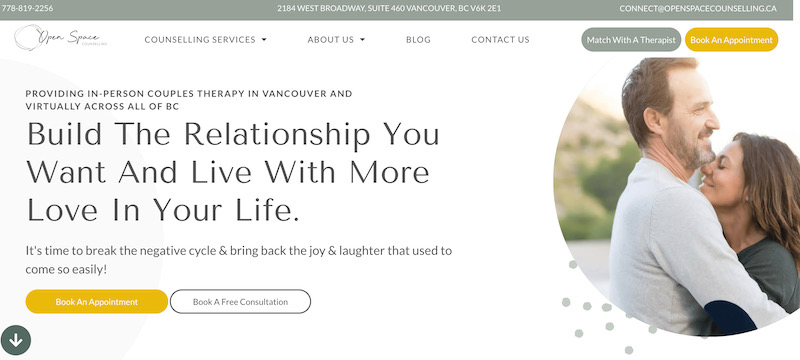
Your headline is the first thing a visitor reads, and it determines whether they stay or leave. For Google Ads traffic, your headline must be consistent with the ad that brought them to the page. If your ad says "Anxiety Therapy in Vancouver," your landing page headline should reinforce that exact promise. Any disconnect between the ad copy and the landing page creates confusion and erodes trust immediately.
For SEO traffic, your headline should clearly communicate what the page is about and match the search intent behind the keyword you're targeting. A strong headline is specific, benefit-driven, and speaks directly to the visitor's situation. Avoid vague or clever headlines, clarity beats creativity every time on a landing page.
2. Ask Questions
One of the most powerful techniques on a landing page is to ask questions that tap into the visitor's pain points. These are questions your ideal client would immediately agree with, questions that make them feel seen and understood before you've even introduced yourself.
For example, if you specialize in anxiety therapy, you might open with:
- Are you tired of lying awake at night with racing thoughts that won't stop?
- Do you find yourself avoiding social situations that used to feel easy?
- Have you tried managing your anxiety on your own, but nothing seems to stick?
When a visitor reads three questions and nods along to each one, they've already started to trust you. They feel like you understand their experience, and that emotional connection is what drives them to keep reading, and eventually to book.
3. List Your Offer & Call to Action

Every landing page needs a clear offer and a call to action, and not just one. If you offer a free consultation, say so explicitly. Make it obvious what the visitor gets by reaching out: a free 15-minute phone call, a no-obligation first session, or whatever your intake process looks like.
Then scatter your call-to-action buttons throughout the page. Don't make visitors scroll all the way to the bottom to find the booking link. Place a CTA after the headline, after the questions section, after the testimonials, and at the bottom. Some visitors are ready to book immediately. Others need more convincing. Give every type of visitor a clear next step at the moment they're ready to take it.
4. FAQ Section
An FAQ section removes the small barriers that stop people from booking. Prospective therapy clients have practical questions that, if left unanswered, can prevent them from taking the next step. Common questions to address include:
- How long are your sessions?
- Do you accept insurance or offer direct billing?
- What should I expect in my first session?
- Do you offer virtual sessions?
- What is your cancellation policy?
Answering these questions directly on the landing page reduces friction. The visitor doesn't have to email you or dig through your website to find basic information. They can make a confident decision right there on the page. An FAQ section also provides additional keyword-rich content that supports your SEO. Understanding the most important SEO factor for therapists will help you make the most of this content.
5. Your Picture & Biography

People don't book with a practice — they book with a person. Including your photo and a brief biography on the landing page is one of the most effective ways to build trust. Your visitor wants to know who they'll be sitting across from (or appearing on screen with), and a warm, professional photo paired with a genuine bio helps them feel comfortable before they even pick up the phone.
Your bio doesn't need to be a full CV. Focus on what matters to the client: your approach to therapy, the types of people you work with, and a sentence or two that shows your human side. Something like "When I'm not in session, you'll find me hiking with my dog or trying a new coffee shop" goes a long way toward making you approachable.
6. Testimonials
Testimonials are social proof, and they carry enormous weight on a therapy landing page. Prospective clients want to hear from people who have been where they are, and who found help through working with you. Strong testimonials typically touch on three things:
- Growth stories: "I came in feeling stuck, and now I have tools I actually use every day."
- Comfortable environment: "I was nervous about starting therapy, but I felt at ease from the very first session."
- Outcomes: "My relationship with my partner has completely changed. We communicate now instead of arguing."
If you don't have testimonials yet, start asking your long-term clients for written reviews. Even two or three strong testimonials can make a significant difference in conversion rates. Place them strategically on the page, ideally near a call-to-action button.
7. List Your Experience & Trainings
Finally, list your relevant experience and training. This isn't about showing off credentials — it's about giving the visitor confidence that you're qualified to help with their specific concern. If you specialize in EMDR, mention your EMDR certification. If you've completed advanced training in couples therapy, include it.
Keep this section scannable. A bulleted list of certifications, years of experience, and notable training programs works better than dense paragraphs. Visitors at this point in the page are looking for reassurance, not a lecture. Give them the facts quickly, and pair this section with a final call to action to book.
A landing page with these seven elements gives you the best possible chance of converting ad clicks and organic search visitors into booked clients. You'll also want to consider crafting web pages to target specific mental health issues as additional landing pages. Each element serves a purpose in the visitor's decision-making process, and together they create a page that educates, builds trust, and makes taking the next step feel natural.

Jordan helps therapists and wellness practitioners get found and get booked. He has run his own SEO, Google Ads, and web design company since 2012, and in 2022 began working specifically with therapy practices across North America.