If you've already set up your Google Business Profile, you're off to a strong start. But creating the profile is only the first step. The real work is in getting it to rank higher than your competitors in local search results. When a potential client searches for a therapist near them, Google decides which profiles to show based on a range of trust and relevance signals. Here are five concrete ways to strengthen those signals and improve your GBP rankings.
#1, Business Listings
Google verifies the authenticity and legitimacy of your practice by cross-referencing your business information across the web. These cross-references are known as citations — mentions of your business name, address, and phone number on other websites and directories.
The more places your practice appears with consistent information, the more confident Google becomes that your business is real, established, and trustworthy. Think of each directory listing as a vote of confidence for your practice.
You should aim to submit your practice to 150 or more directories. That number sounds daunting, but many of them are general business directories, healthcare directories, and local directories that accept free submissions. Services exist that can handle bulk submissions for you, saving hours of manual work. The key directories to prioritize include:
- Yelp
- Yellow Pages
- Bing Places
- Apple Maps
- Healthcare-specific directories relevant to your profession
- Local chamber of commerce and city directories
Every listing you create is another signal telling Google that your practice is legitimate and worth showing to searchers.
#2 — Consistent NAP
NAP stands for Name, Address, and Phone number. It's one of the most fundamental ranking factors for local search engine optimization for therapists, and it's the one that most often gets overlooked or mishandled.
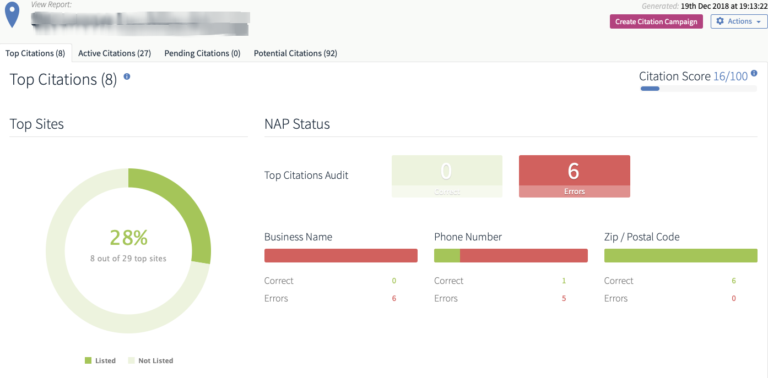
Your NAP must be completely uniform across every single directory where your practice appears. That means the exact same business name, the exact same address format, and the exact same phone number. Even small inconsistencies can hurt you. If one directory lists your practice as "Toronto Counselling Services" and another lists it as "Toronto Counseling Services Inc.", Google treats those as potentially different businesses.
Common inconsistencies to watch for:
- Abbreviations (St. vs Street, Ste. vs Suite)
- Spelling variations (Counselling vs Counseling)
- Including or excluding "Inc." or "Ltd."
- Different phone numbers for different listings
A tool like Brightlocal can help you monitor your NAP consistency across all directories and flag discrepancies before they become a problem. Regular audits of your business listings are essential for maintaining strong local rankings.
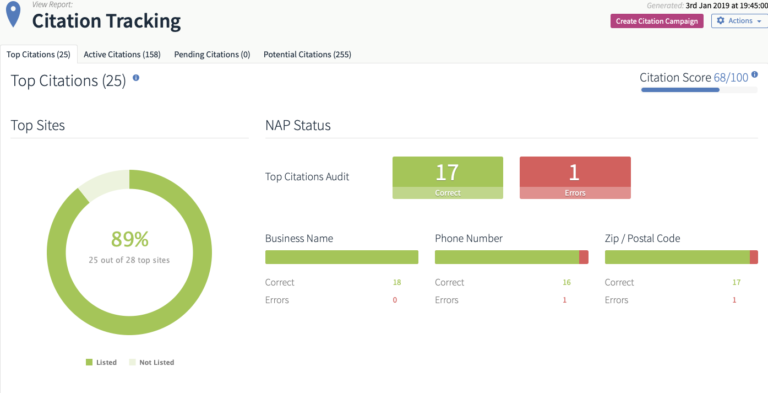
Here's an example of a poor NAP score — inconsistencies like these hurt your rankings:
#3, NAP On Your Website
Your own website is the most authoritative source of information about your practice. Google crawls your site regularly, and it expects to find your business details clearly displayed there.
At minimum, your name, address, and phone number should appear on your website, ideally in the footer of every page and on a dedicated contact page. This gives Google a consistent reference point to compare against your directory listings.
Beyond simply displaying your contact information, you should also add Schema markup (structured data) to your website. Schema is a standardized code format that tells search engines exactly what your business information means. Instead of Google having to interpret your address from the page layout, Schema markup explicitly labels it as a business address, phone number, operating hours, and more.
Schema markup is like handing Google a neatly organized business card instead of making it search through your entire website for your details.
Your web developer can implement LocalBusiness Schema on your site, or you can use plugins if you're on WordPress. The result is a cleaner, more confident signal to Google about who you are and where you're located.
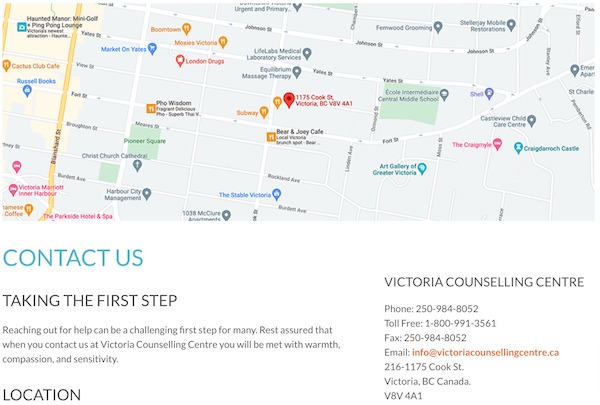
#4, Embedded Google Map
Adding an embedded Google Map to your contact page is a simple but effective way to reinforce your physical location to Google. When you embed your GBP map directly on your website, you're creating a direct link between your website and your Google Business Profile.
This helps Google verify that the address on your website matches the address on your GBP, which strengthens the overall trust signal. It also provides a better user experience for potential clients who want to see exactly where your office is located before they book.
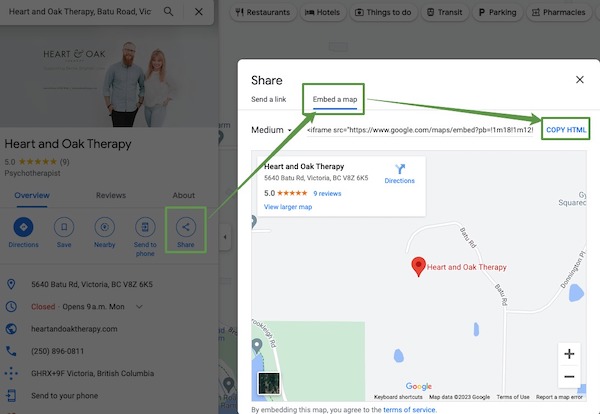
To embed your map, search for your practice on Google Maps, click "Share," select "Embed a map," and paste the provided code into your contact page. It takes less than five minutes and provides a lasting SEO benefit.
#5, Reviews
Reviews are one of the most powerful ranking factors for Google Business Profiles. Google has confirmed that review quantity, frequency, and quality all influence local rankings. Practices with more reviews tend to rank higher, appear more trustworthy, and attract more clicks.
Aim to accumulate 20 or more reviews as a starting baseline. Once you pass that threshold, you'll often see a noticeable impact on your rankings. But don't stop there — ongoing review generation keeps your profile fresh and signals to Google that your practice is active.
Practical ways to generate more reviews:
- QR code posters in your waiting room that link directly to your Google review page
- Email signature links with a simple "Leave us a review" call to action
- A follow-up email after a session thanking the client and including a review link
- A small card handed to clients at checkout with a QR code
Make the process as easy as possible. The fewer steps between your request and the review submission, the more reviews you'll receive. And remember, never incentivize reviews. Google's policies prohibit it, and it can result in your reviews being removed or your profile being penalized.
These five strategies work together. Business listings build your citation foundation. Consistent NAP ties everything together. Your website reinforces the data. An embedded map creates a direct connection. And reviews add the social proof that sets you apart. Tackle them one at a time, and you'll see your GBP rankings improve steadily over the coming months.

Jordan helps therapists and wellness practitioners get found and get booked. He has run his own SEO, Google Ads, and web design company since 2012, and in 2022 began working specifically with therapy practices across North America.