One of the most effective SEO strategies for therapists is creating dedicated webpages that target the specific issues you treat and the types of therapy you provide. Instead of listing everything you offer on a single "Services" page, you break it out — one page per issue, one page per modality. Each page becomes a focused entry point that matches what potential clients are actually searching for.
This approach works because Google rewards specificity. A page titled "Couples Therapy in Vancouver" that's entirely about couples therapy will outrank a generic services page that mentions couples therapy alongside twelve other things. Let's look at how to do this well.
How to Format SEO Page Titles and URLs
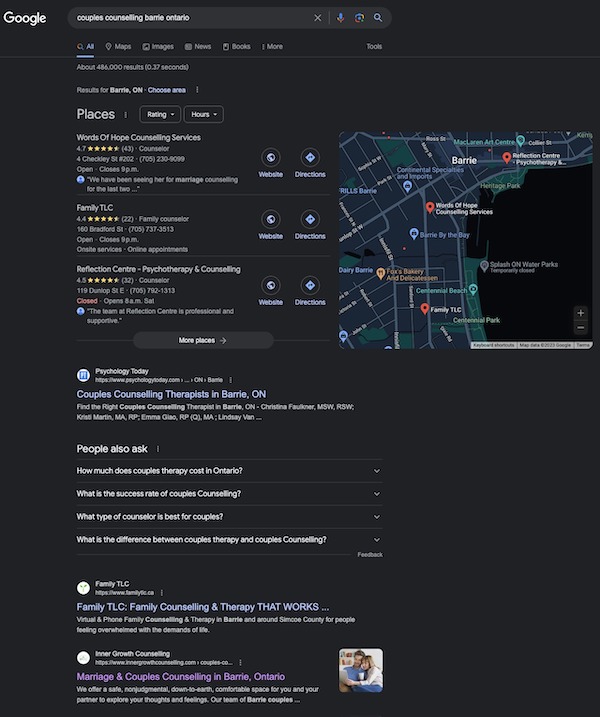
Your page title and URL structure matter more than most therapists realize. They tell Google what the page is about and they're the first thing a searcher sees in the results.
Take couples therapy as an example. You could structure your URL and title in several ways:
- /couples-therapy-vancouver — "Couples Therapy in Vancouver"
- /couples-counselling-vancouver — "Couples Counselling in Vancouver"
- /marriage-counselling-vancouver — "Marriage Counselling in Vancouver"
Each variation targets a slightly different search phrase. People use different terms to describe the same service, and each one represents a real search with real volume. You don't need to create pages for every possible variation — start with the highest-volume term and expand from there.
Alternate your page title structure to keep things natural. If every page title follows the exact pattern of "Service + City," it starts to look templated to both Google and visitors. Mix it up: "Anxiety Therapy in Toronto," "Find Depression Counselling in Toronto," "Toronto EMDR Therapy — Heal From Trauma." Variety signals that each page was thoughtfully created.
Where to Start?
Before you start building pages, research what's already ranking for your target terms. Search for "anxiety therapy [your city]" and study the top results. What pages are ranking? How long are they? What topics do they cover? This gives you a baseline for what Google considers relevant and authoritative for that search.
For most therapy practices, the highest-priority pages to create cover the most commonly searched issues:
- Couples therapy / marriage counselling — consistently one of the highest-volume therapy searches
- Anxiety therapy — another heavily searched term in nearly every city
- Depression counselling — high search volume with strong intent
- Trauma therapy / PTSD treatment — increasingly searched, especially post-pandemic
- Grief counselling — a service many people search for during acute need
Start with the issues that align with your expertise and your ideal client. There's no point ranking for couples therapy if you don't enjoy doing couples work. Build pages for the services you want to fill your schedule with.
Webpages to Target Specific Therapies
Beyond issue-specific pages, you should also create pages for the therapeutic modalities you use — especially if they have name recognition and search volume.
CBT (Cognitive Behavioural Therapy): CBT is one of the most widely recognized therapy approaches among the general public. People actively search for "CBT therapist near me" or "cognitive behavioural therapy [city]." A dedicated CBT page positions you to capture that traffic.
EMDR (Eye Movement Desensitization and Reprocessing): EMDR has grown significantly in public awareness. Potential clients often search specifically for EMDR practitioners, especially for trauma-related concerns. If you're trained in EMDR, a dedicated page is essential.
IFS (Internal Family Systems): IFS has a devoted following and growing search volume. People who know they want IFS therapy search for it by name. A dedicated page helps you appear for those specific, high-intent searches.
For each modality page, explain what the therapy involves in plain language, who it's best suited for, what a typical session looks like, and how it differs from other approaches. Avoid clinical jargon that your potential clients won't understand.
The Hidden Benefit of Creating More Webpages
Beyond targeting individual search terms, there's a structural SEO benefit to creating multiple service pages: the hub-and-spoke model.
Think of your main services page as the hub. Each dedicated issue or modality page is a spoke. When you link the spokes back to the hub and interlink them with each other, you create a tight cluster of related content that signals to Google that your site has deep expertise in therapy services. This internal linking structure strengthens every page in the cluster.
For example, your anxiety therapy page can link to your CBT page ("I use CBT techniques to help clients manage anxiety"). Your CBT page can link to your depression page ("CBT is also highly effective for depression"). Your depression page can link back to your main services page. Each link reinforces the relevance of the others.
Aim for a minimum of 500 to 600 words per page. This gives Google enough content to understand the topic and gives visitors enough information to feel confident reaching out. Pages that are too thin — a paragraph or two — tend to perform poorly in search results and can even be seen as low-quality content.
Here are the key takeaways to keep in mind:
- Create one dedicated page for each major issue you treat and each modality you use
- Structure your URLs and titles around the terms your potential clients search for
- Research what's already ranking before writing your pages
- Interlink your service pages to build topical authority
- Write at least 500 to 600 words per page — thin content won't rank
- Start with your highest-priority services and expand over time

Jordan helps therapists and wellness practitioners get found and get booked. He has run his own SEO, Google Ads, and web design company since 2012, and in 2022 began working specifically with therapy practices across North America.