Social media can be a powerful tool for therapists who want to grow their practice and reach more of the people who need their help. Facebook and Instagram, in particular, offer unique opportunities to build your professional presence, share your expertise, and connect with potential clients in a way that feels authentic and approachable.
The key is knowing how to use each platform effectively without feeling overwhelmed or compromising your professional boundaries. Here is a practical guide to getting started with Facebook and Instagram marketing for your therapy practice.
Facebook Marketing

Facebook remains one of the most effective platforms for therapists to build a professional online presence. With billions of active users and robust business tools, it provides a direct channel to the communities you serve.
Growing your presence. Start by making your Facebook business page easy to find. Add your page link to your email signature so that every professional email you send becomes a subtle invitation to connect. Place a Facebook icon or link prominently on your website — in the header, footer, or both. Share your page from your personal profile to let friends and family know about your practice, as word-of-mouth referrals often start with the people closest to you.
Cross-promotion is another effective strategy. If you have profiles on Psychology Today, GoodTherapy, or other therapist directories, include your Facebook page link in those listings. The more places your page appears, the more opportunities people have to find and follow you.
Profile optimization. Your Facebook business page is often the first impression a potential client will have of your practice on social media. Use a professional headshot as your profile photo — not a logo, not a group photo, but a warm, approachable image of you. People want to see the face of the person they might be opening up to.

Your cover image is prime visual real estate. Use it to communicate what you do and who you serve. A clean graphic with your tagline, areas of specialty, or a calming image that reflects the tone of your practice works well. Fill out every section of your page completely — About, Services, Contact Information, and Hours. The more complete your profile, the more credible you appear to both potential clients and search engines. A strong social presence complements your SEO strategy.
Instagram Marketing

Instagram is a visually driven platform that works exceptionally well for therapists who want to share educational content, build community, and humanize their practice. It skews slightly younger than Facebook, making it especially valuable if you work with young adults, college students, or millennials.
Setting up your account. Switch to a business account if you have not already. This gives you access to analytics, the ability to run ads, and additional contact buttons on your profile. Choose a username that is easy to find and clearly connected to your practice name, avoid underscores and numbers when possible.
Crafting your bio. Your Instagram bio is limited to 150 characters, so every word counts. Include what you do, who you help, and a clear call to action. Something like: "Anxiety & trauma therapy in Vancouver. Helping you find calm in the chaos. Book a free consult below." Use the single link in your bio wisely — point it to your booking page, a Linktree with multiple options, or a dedicated landing page.
Quality over quantity. You do not need to post every day. Consistency matters more than frequency. Two to three well-crafted posts per week will serve you far better than daily posts that feel rushed or generic. Focus on content that educates, normalizes mental health conversations, and showcases your expertise.
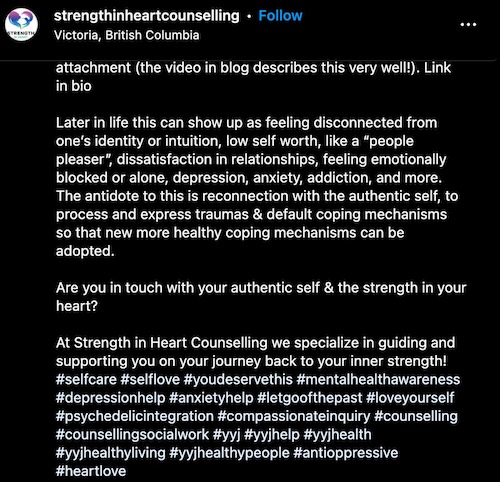
Hashtag strategy. Hashtags are how new people discover your content on Instagram. Use a mix of broad hashtags like #therapistsofinstagram and niche-specific ones like #anxietytherapyvancouver or #couplescounsellingtips. Research what hashtags other therapists in your area are using, and aim for a mix of popular and less competitive tags to maximize your reach.
Location geotagging. Always tag your location when posting. This is a simple but often overlooked step that significantly increases your visibility to people searching for services in your area. When someone searches for content near your city or neighbourhood, geotagged posts are more likely to appear in their results.
Content Strategy
The content you share on Facebook and Instagram should serve a clear purpose: educate, build trust, and guide people toward your practice. Here are practical strategies for creating content that achieves all three.
Blog integration. If you are writing blog posts for your website, and blogging should be part of your strategy, repurpose that content for social media. Turn a blog post about managing holiday stress into a carousel of tips on Instagram, or share a key takeaway as a Facebook post with a link back to the full article. This approach saves time and drives traffic to your website simultaneously.
Conference insights. When you attend professional conferences, workshops, or training sessions, share what you are learning. A post about a new technique you explored or a research finding that excited you positions you as someone who is continuously growing and investing in your craft. It also gives your audience valuable insight into the depth of your expertise.
Research commentary. When new studies are published in your areas of specialty, share your professional perspective. Break down complex findings into language your audience can understand, and explain what the research means for the people you work with. This type of content is incredibly shareable and positions you as a thought leader in your niche.
Maintain your focus. It is tempting to post about everything under the sun, but the most effective therapy social media accounts stay focused on their areas of expertise. If you specialize in anxiety and OCD, the majority of your content should address those topics. Occasional personal posts are fine and even encouraged — they humanize your practice — but your core content should consistently reinforce what you are known for.
Scheduling. Use a scheduling tool like Later, Buffer, or Meta's built-in scheduling features to plan your content in advance. Batching your content creation — sitting down once a week or once a month to plan and write several posts — is far more sustainable than trying to come up with something new every day.
Privacy considerations. Never share client information, stories, or details that could identify someone, even with permission. The ethical boundaries around confidentiality apply fully to social media. Stick to general educational content, your professional insights, and anonymized themes from your work.
Cross-platform posting. Many therapists find it efficient to post the same or similar content on both Facebook and Instagram. While each platform has its nuances, the core message can often be adapted with minor adjustments. A carousel post on Instagram can become a photo album or article link on Facebook. This approach doubles your reach without doubling your workload.
Social media marketing for therapists does not need to be complicated or time-consuming. Start small, stay consistent, and focus on creating content that genuinely helps the people you want to reach. Over time, your social media presence will become a reliable source of new client inquiries and a powerful extension of your practice's brand.

Jordan helps therapists and wellness practitioners get found and get booked. He has run his own SEO, Google Ads, and web design company since 2012, and in 2022 began working specifically with therapy practices across North America.